Friday, March 6, 2009

Oh! Hey! Stripped-down Soul Beauty


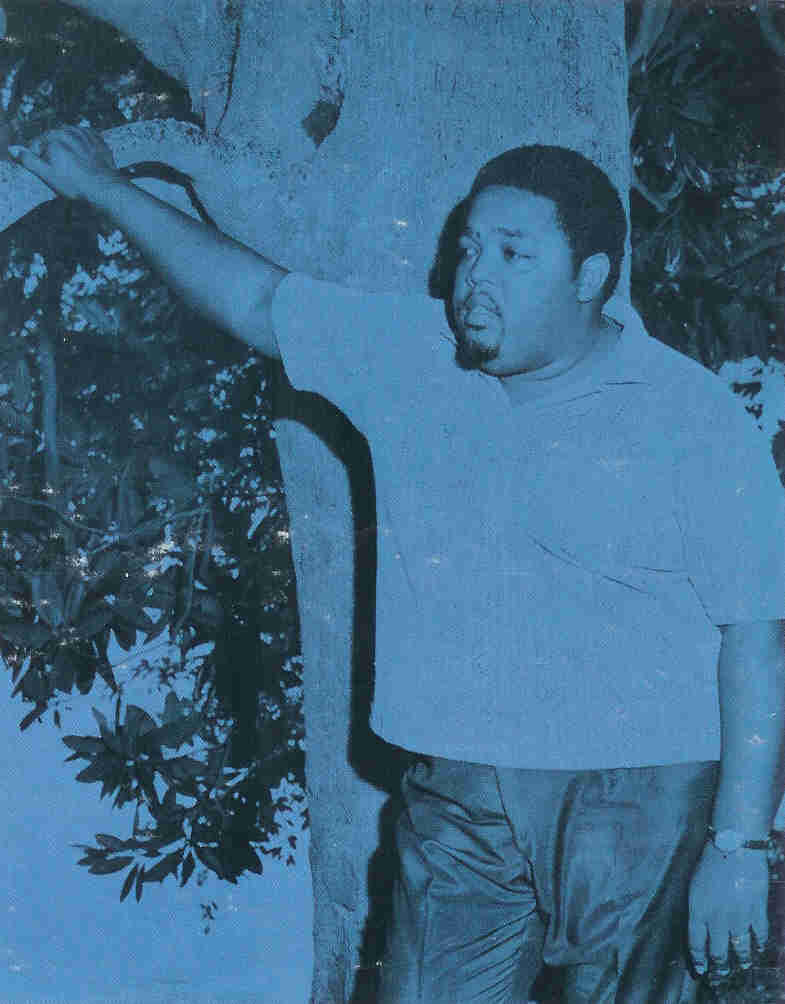
The Enigmatic Lee Moses on his Bad Girl, ostensibly so bad that she warranted two sides of a single and a follow-up, She's A Bad Girl. Well I for one am grateful for her obstinate disobedience if it led to this raw, perspiring Memphis soul power house jam (from his album "Time and Place" released by the New Jersey All Platinum imprint, Maple):


Thursday, March 5, 2009

Weird Science Science - The Antology


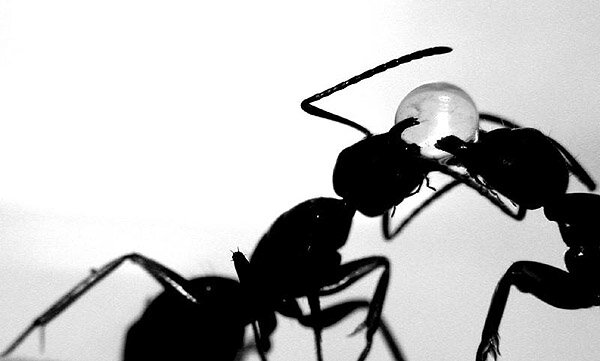
Alex Wild is a photographer who specializes in insect photography. His website truly is extraordinary and his assiduous documentation of ants is incredibly extensive. This ant's pollinating!
----------------------------------------------------------------------------------
We have so much to learn from the social behavior of diminutive species.

The Virtues of Ants: The individual benefiting from group cooperation,
symbiotically interacting with our ecosystem , patience, self-sacrifice, adaptability.

Human traffic congestion issues solved by observing ants sophisticated travel flow algorithims and bio-social systems of cooperation?
Sure, why not.

"One dominating factor in human traffic is egoism. Drivers optimize their own travel time, without taking much care about others. This leads to phantom traffic jams which occur without any obvious reason. Ants, on the other hand, are not egoistic."

Exhaustive Book Review of The Superorganism: The Beauty, Elegance, and Strangeness of Insect Societies, discusses fascinating aspects of ant life

You should really read the review, but i know you won't:

"Parallels between the ants and ourselves are striking for the light they shed on the nature of everyday human experiences. Some ants get forced into low-status jobs and are prevented from becoming upwardly mobile by other members of the colony. Garbage dump workers, for example, are confined to their humble and dangerous task of removing rubbish from the nest by other ants who respond aggressively to the odors that linger on the garbage workers' bodies."

"Some of the most fascinating insights into ants have come from researchers who measure the amount of carbon dioxide given off by colonies. This is rather like measuring the respiration rate in humans in that it gives an indication of the amount of work the superorganism is doing. The researchers discovered (perhaps unsurprisingly) that colonies experiencing internal conflict between individuals seeking to become reproductively dominant produce more CO2 than do tranquil colonies where the social order is long established. But extraordinarily, they also discovered that about three hours after removing a queen ant, the CO2 emissions from a colony drop. "Removing the queen thus has a clear effect on worker behavior, apparently reducing their inclination to work for the colony," the researchers concluded. While it's dangerous to anthropomorphize, it seems that ants may have their periods of mourning just as we humans do when a great leader passes from us."

"The means that ants use to find their way in the world are fascinating. It has recently been found that ant explorers count their steps to determine where they are in relation to home. This remarkable ability was discovered by researchers who lengthened the legs of ants by attaching stilts to them. The stilt-walking ants, they observed, became lost on their way home to the nest at a distance proportionate to the length of their stilts."

"Pheromone trails are laid by ants as they travel, and along well-used routes these trails take on the characteristics of a superhighway. From an ant's perspective, they are three-dimensional tunnels perhaps a centimeter wide that lead to food, a garbage dump, or home. If you wipe your finger across the trail of ants raiding your sugar bowl, you can demonstrate how important the pheromone trail is: as the ants reach the spot where your finger erased their trail they will become confused and turn back or wander. The chemicals used to mark such trails are extraordinarily potent. Just one milligram of the trail pheromone used by some species of attine ants to guide workers to leaf-cutting sites is enough to lay an ant superhighway sixty times around the earth."

"Some ant species do not have queen ants in the strict sense. Instead, worker ants (which are all female) that have mated with a male ant become the dominant reproductive individuals. These are the gamergates, or "married workers," and their sex life can be brutal. In one species the gamergates venture outside of the nest to attract a male, engage him in copulation, then carry him into the nest before snipping off his genitals and throwing away the rest of his body. The severed genitals continue to inseminate the gamergate for up to an hour, after which they too are discarded. The fertilized gamergates then vie for dominance, causing disruptive conflict in the nest. Sometimes an oligarchy of gamergates is established, but in other instances a single gamergate triumphs. You might think that such an established gamergate would watch the colony carefully for signs of emerging rivals, but this is not the case. Instead it's the worker ants that do so by taking a keen interest in the sexual status of their sisters. If they sense that one is becoming a sexually active gamergate, they will turn on her, either assaulting her or watching carefully until she produces eggs, which they promptly consume. It's intriguing that the sterile workers play the role of monitoring and regulating the sexual life of the colony. In a stretch of the imagination, I can see parallels between this behavior and the role of policing and censuring the sex lives of the rich and famous that gossip magazines play in our own society."

"The progress of ants from this relatively primitive state to the complexity of the most finely tuned superorganisms leaves no doubt that the progress of human evolution has largely followed a path taken by the ants tens of millions of years earlier. Beginning as simple hunter-gatherers, some ants have learned to herd and milk bugs, just as we milk cattle and sheep. There are ants that take slaves, ants that lay their eggs in the nests of foreign ants (much like cuckoos do among birds), leaving the upbringing of their young to others, and there are even ants that have discovered agriculture. These agricultural ants represent the highest level of ant civilization, yet it is not plants that they cultivate, but mushrooms. These mushroom farmers are known as attines, and they are found only in the New World. Widely known as leafcutter ants, they are doubtless familiar from wildlife documentaries. The attines, say Hölldobler and Wilson, are "Earth's ultimate superorganisms," and there is no doubt that their status is due to their agricultural economy, which they developed 50 to 60 million years before humans sowed the first seed. Indeed, it is in the changes wrought in attine societies by agriculture that the principal interest for the student of human societies lies. The most sophisticated of attine ant species has a single queen in a colony of millions of sterile workers that vary greatly in size and shape, the largest being two hundred times heavier than the smallest. In the case of the attines, however, the varying size classes have specific jobs to do. Some cut a piece from a leaf and drop it to the ground, while others carry the leaf fragment to a depot. From there others carry it to the nest, where smaller ants cut it into fragments. Then ants that are smaller still take these pieces and crush and mold them into pellets, which even smaller ants plant out with strands of fungus. Finally, the very smallest ants, known as minims, weed and tend the growing fungus bed. These minute and dedicated gardeners do get an occasional outing, however, for they are known to walk to where the leaves are being cut and hitch a ride back to the nest on a leaf fragment. Their purpose in doing this is to protect the carrier ants from parasitic flies that would otherwise attack them. Clearly, not only did the attines beat us to agriculture, but they exemplified the concept of the division of labor long before Adam Smith stated it. You may not believe it, but like the sailors of old the leafcutter ants "sing" as they work. Leaf-cutting is every bit as strenuous for the ants as hauling an anchor is for human beings, and their singing, which takes the form of stridulation (a sound created by the rubbing together of body parts), assists the ants in their work by imparting vibrations to the mandible that is cutting the leaf, enhancing its action in a manner akin to the way an electric knife helps us cut roasts. The leafcutters also use stridulation to cry for help, for example when workers are trapped in an underground cave-in. These cries for help soon prompt other ants to rush in and begin digging until they've reached their trapped sisters. The fungus farmed by the leafcutter ants grows in underground chambers whose temperature, humidity, and acidity are precisely regulated to optimize its growth. The fungus, which produces a tiny mushroom, grows nowhere else, and genetic studies reveal that various attine ant species have been cultivating the same fungus strain for millions of years. In truth, after tens of millions of years of coevolution such is their interdependence that the ants cannot live without the fungus, nor the fungus without the ants. The system is not perfect, however, for the ants' fungal gardens are occasionally devastated by pests. One of the worst is an invasive fungus known as Escovopsis, whose depredations can become so severe that the leafcutters must desert their hard-won gardens and start elsewhere anew. Often a colony so beset evicts a smaller attine colony, taking over the premises and enlarging them to suit. Fortunately, the ants possess a potent defense against this fungal weed that usually prevents its proliferation. Their fungicide is produced by a bacterium that is found only in pits located on specific parts of the ants' bodies, and that is known to exist nowhere else. These bacteria produce secretions that not only destroy the Escovopsis pest, but promote the growth of the fungus the ants wish to cultivate. Thus these special bacteria must be considered as comprising the third element in a triumvirate of coevolved organisms, whose fate is now so closely interwoven that they are utterly interdependent and form a single, functional whole. Humanity's dependence upon a few grains—principally wheat and rice—and the complete dependence on cultivated varieties of these plants by human farmers presents a similar symbiosis.""

So think twice before you temerariously squash these sophisticated critters.

------------------------------------------------------- -------------
More Alex Wild:


An Australian seed-harvesting ant in the genus Meranoplus drags a seed back to her nest.


Mating Acropyga ants, the queen carrying a mealybug in her mandibles. Acropyga ants feed on secretions by root-feeding mealybugs, and the mealybugs depend on the ants for dispersal and protection. When young queen ants leave the nest to mate and start new colonies, they carry their nest-founding mealybug with them.


Ants as earthbound creatures are not ideal pollinators, but they can carry pollen over short distances.


Ant colonies maintain social cohesion through the frequent sharing of regurgitated liquid food. This activity is called trophallaxis, seen here among painted members of a laboratory study colony.


---------------------------------------------------------

And finally, My personal favorite parasitic-symbiotic-interspecial relationship: Zombie ants.
Friday, February 27, 2009

Whore-hey Looee Boar-hay-zs

The Witness (El Testigo) by Jorge Luis Borges (1899-1986)

In a stable that stands almost within the shadow of the new stone church, a man with gray eyes and a gray beard, sprawled amidst the odor of the animals, humbly seeks his death as though he were seeking sleep.

The day, faithful to vast, secret laws, moves about displacing and blending the shadows in that modest place; outside there are plowed fields, and a ditch clogged with dried leaves, and perhaps some faint tracks of a wolf upon the black clay at the edge of the forest.

The man sleeps and dreams, forgotten. The tolling bells that call to prayer awaken him. In the kingdoms of England, the summoning of the bells has already become part of the evening’s routine; but, in his boyhood, the man has seen the face of Woden, the divine horror and exultation, the cumbrous wooden idol overladen with Roman coins and unwieldy vestments, the sacrifice of horses, dogs and prisoners. The man will die before dawn, and along with him will also perish, never to return, the last direct, eyewitness images of the pagan rites. The world will be poorer once this Saxon man has died.

We may wonder at events that exist in space, but reach their end when someone dies; and yet some thing, or an infinite number of things, dies and is lost along with anyone’s death, unless there actually exists a universal memory, as the theosophists have speculated. Over the course of time, there came a day that forever blinded the last eyes to have witnessed Christ; the Battle of Junín, and the love of Helen, died with the death of some one.

What shall die with me when I die? What pathetic or inconsequential form will the world nevertheless lose? The voice of Macedonio Fernández, the memory of a bay horse in an empty lot at the corner of Serrano and Charcas, a bar of sulfur inside the drawer of a mahogany desk?

─ Translated from El hacedor (1960) by Andras Corban Arthen

The "Nite Brite" Phenomenon: A Distinction


Phosphorescence
:
a process in which energy absorbed by a substance is released relatively slowly in the form of light. This is in some cases the mechanism used for "glow-in-the-dark" materials which are "charged" by exposure to light. Unlike the relatively swift reactions in a common fluorescent tube, phosphorescent materials used for these materials absorb the energy and "store" it for a longer time as the processes required to re-emit the light occur less often.


Fluorescence
:
a luminescence that is mostly found as an optical phenomenon in cold bodies, in which the molecular absorption of a photon triggers the emission of a photon with a longer (less energetic) wavelength. The energy difference between the absorbed and emitted photons ends up as molecular rotations, vibrations or heat. Sometimes the absorbed photon is in the ultraviolet range, and the emitted light is in the visible range


Bioluminescence:
the production and emission of light by a living organism as the result of a chemical reaction during which chemical energy is converted to light energy.The chemical reaction can occur either inside or outside the cell. In bacteria, the expression of genes related to bioluminescence is controlled by an operon called the Lux operon. Bioluminescence has appeared independently several times (up to 30 or more) during evolution. Bioluminescence occurs in marine vertebrates and invertebrates, as well as microorganisms and terrestrial animals. Symbiotic organisms carried within larger organisms are also known to bioluminesce.


Ars Gratia Artis

From Juxtapox magazine: "Check out this trippy five-minute video, Khoda, by Reza Dolatabadi. Dolatabad is a graduate film student who made this film from 6,000 individual paintings shown at a rate of 20 per second. It took over two years to complete and is pretty mind-blowing."


Khoda from Reza Dolatabadi on Vimeo.

As much as I think the artist's style is a little too comic book-y for me, the sheer magnitude of effort, focus, determination, and patience that this project demands is inspiring. It reminds me in some ways of underground avant-garde film visionary ("vision-ree"), dreamweaver, and facepainter? Stan Brakhage.

Since the inception of his filmaking in the late 1950's Brakhage has pioneered scores of experimental techniques that are ubiquitious in all genres of cinematography today. Particularly germane here was his penchant for sedulously hand painting directly on individual celluloid frames, treating each of them as if they were mini-canvases, works of art in of themselves. He would then project these micro-cathedrals of color and time at 24 fps using 16mm projector.

The result:


To aid in his assiduously prescient transfiguration of traditional cinema, he employed other techniques such as fast cutting, in-camera editing, scratching film, double-exposure, reverse film looping, etc. Most of his pieces are silent, in color, and range from a few seconds (Eye Gaze) to feature length (Text of Light). The means themselves were Brakhage's ends (as is true for all 'ars gratia artis'): just as much as he aimed to create a finite, condensed visual stimulus, each creatively nascent and exploratory process seemed to be just as vital to him and the success of his work.

See also: Maya Deren, Kenneth Anger

Wednesday, February 25, 2009

Grease meets pest


Black Lips channel their 1960's
pork pie plumber bum garage revivalist herion-sheik trash influences shamelessly and to great effect on their new ELPMAH (Extended Long Play Music Album for Humans...c'mon you knew that). Less of what you'd expect from their previous bluesy indie-rock inflected beer spraying "flower punk" (their own *yuck* euphemism) and more of a succession of opiate-induced hot nods to the purveyors of good types of sound like The Kinks and Velvet Underground. Things happen with music when listening. Singer Alexander Cole pays tribute to the late great Joe Strummer in track 8, BBBJOT, hijacking Strummer's trademark proncouncement of the word "fail" (as in "Rude can't fay-all").
Speaking of that track, these are some of the lyrics:

It don't matter what they say
He cant be the Jack Johnson of the day
Big, black baby jesus on the way. C'mon!
The Jesus of today. C'mon!
Do it, do it today, big, black Jesus on the way.
It don't matter what they say.

Track 11, The Drop I Hold finds Cole dropping some slow-ass drug-addled white boy rhymes over a great lazy, west-coast rhythm with a 97.1 worthy-hook. Stylistically, this song stands on its tippy toes as it refreshingly creeps up on you past the dozen plus tracks of effortless fuzzed-out drug jams. So what the hell about all this? Well they lose the disorientingly euphoric experimental loops and drum triggers (which really helped set themselves apart from the scene of snore) and plug raw into tube amps. It's nothing new, but I love the Kinks and Velvet Undergound, so to get down with some New York contemporary shitpster-ish, 20-something, fun-loving boredom crashers who drop $$$$ to get the best worst guitar tones and devote their lives to singing out of key and tapping into the pot-hazy, sexy apathy of some of the best bands of the 20th century is a thing I'll do.

try it.

Tuesday, February 24, 2009

Thursday, February 19, 2009

Let's crow old together...

It's no secret, these murderous jet black winged enigmas are fiercely intelligent. So much so that evidence of their zoological cognitive feats beg repudiation of the negative "bird brain" colloquialism. There are two phenomenon in particular that prove that crows have something going for them in the evolutionary gene pool:

1) This first one is illustrative of crows' impressive ability to adapt to an urban environment that has been exponentially constructed around them. Whereas other less adaptable birds would migrate or change food sources to survive, crows dig in their awkward lil' heels and make do with what they've got:


2) One defining characteristic of an intelligent animal is if they can use tools to their advantage in the wild to solve novel problems. Crows? Check. Specifically, New Caledonian Crows create hooked probes from twigs in order to obtain food. They have developed this behavior over thousands of years of rich crow stick-bending tradition and evolution, therefore the story of a crow named Betty is all the more intriguing.

Betty was caught as a child and put in captivity with Abel, a male who spent the last 10 years in a zoo. A small bucket of pig heart (crow's fave) was placed in a pipe and the crows were presented with a straight wire and one already bent into a hook. Abel, being the opportunistic male that isolation has turned him into, grabbed the hook and took off, leaving Betty to her own devises. So, she strategically bent the straight wire into a hook using her beak and feet in order to get to the food. This is the first time an animal had been observed making a hook out of unnatural material to solve a novel problem. Get it girl! To make sure this wasn't a fluke, Betty was tested with Abel again, this time with just a straight wire to go on. 9 out of 10 times, Abel laid back while Betty turned it out by fabricating a hook and obtaining the grub.

Now, it's real sweet because..."The researchers say that Betty's creation of hooks cannot be attributed to the shaping or reinforcement of randsomly generated behavior. And since she had no other crows to model, no training with pliant objects, and very limited prior experience with wire, they see her actions as novel and purposeful. " So even though she has probably seen and taken part in past behavior that involved creating hooks in the wild, Betty had to adapt those experiences to solve a completely new problem, something pretty 'heady' for a lil' bird brain. I mean scientists are saying that Crows may even surpass Chimps in their ability to use tools to their advantage.

"This is how they do it" (this is how they do it):


How it gets done in the wild (note the meticulous selection of twigs and leaves needed to engineer the hook):

Wednesday, February 18, 2009

Cueva de las Manos


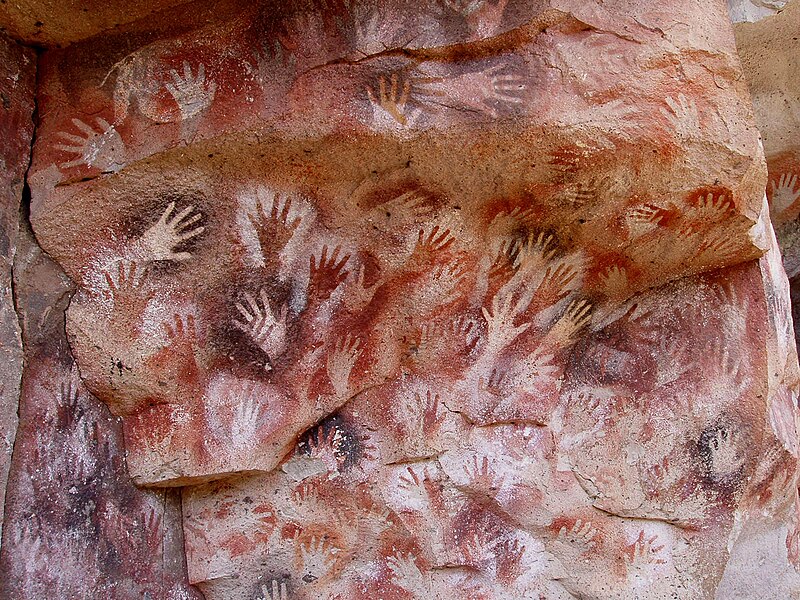
Let's go to Patagonia! Now what you have here is an archetypal example of a been-there-dreamed-that, dime a dozen, I'm yawning again caus' I'd rather be watchin' Gossip Girl, run of the mill and stuck in a well "Cave of the Hands". Located in the southern region of South America (yep, good ol' Santa Cruz, Argentina), this cave lies deep in the valley of the Pinturas River (River of Paintings). Ostensibly someone deemed this 79ft x 49ft hole in the Earth important enough to be protected as a UNESCO (eh hem: United Nations Educational, Scientific, and Cultural Organization) World Heritage Site on the basis of "paleontological and archaeological historical importance". Go figure.

Clearly this cave gets it's name from the sundry stencils of left-hands painted on the cave walls some 9,000 years ago. The paintings were able to be dated by means of the tools that were found at the scene of the crime. The indigenous inhabitants of the land at that time (quite possibly forefathers of the Tehuelches, Ferdinand Magellan's "Giant People") used bone-made pipes to shoot mineral ink onto the walls, blocked by their hands, therein creating perhaps the world's first stencil art. (Banksy et Le Rat eat your poser hearts out...)

Apparently it was a rite of passage for these graffiti-loving natives to mark their journey into manhood in this cave because the size of the hands resemble that of a 13-year old boy. However it could very well be that they were older, as primitive civilizations tend to be all gross and under-developed like.

Wait, wait, wait, wait. That's not it. As if these flawlessly preserved demarcations of ancient rituals and artistic expression aren't enough to satisfy your curiosity for all things Patagonian, there's also... more paintings! Cueve de las Manos and a few sister caves have been tastelessly littered with depictions of humans, guanacos, rheas, felines, geometric shapes, some zigzag patterns, representations of the sun, and some hunting scenes for good measure. Really all your standard hunter and gatherer fare. The ceilings of these caves also glisten with thick, red dots, supposedly created by the never-gets-old method of dipping your bola in red ink and recklessly splattering your local cave ceiling with it.

This is more information: "The colours of the paintings vary from red (made from hematite) to white, black or yellow. The negative hand impressions are calculated to be dated around 550 BC, the positive impressions from 180 BC, and the hunting drawings to be older than 10,000 years".

So, are we going or not?

Tuesday, February 17, 2009

whoa!

So, guys, the news.

What are the haps in the news?