Let's go to Patagonia!
 Now what you have here is an archetypal example of a been-there-dreamed-that, dime a dozen, I'm yawning again
caus' I'd rather be
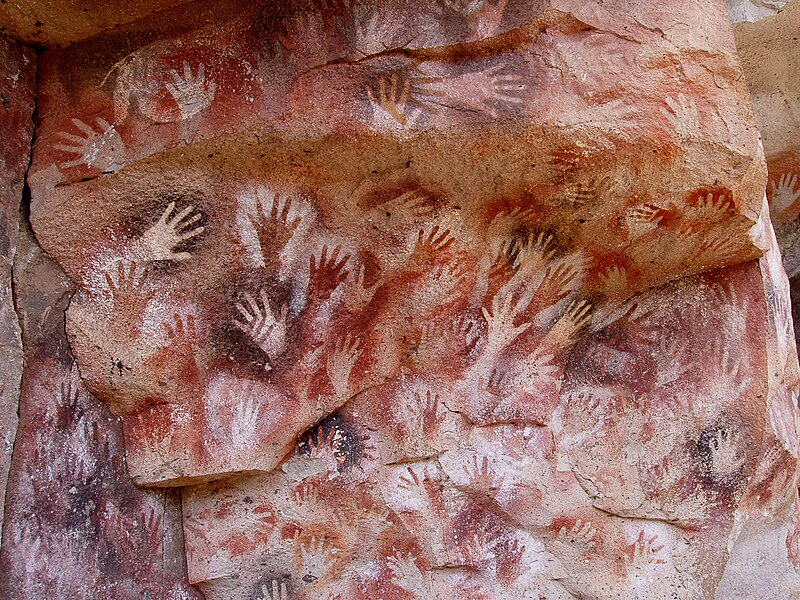
watchin' Gossip Girl, run of the mill and stuck in a well "Cave of the Hands". Located in the southern region of South America (yep, good
ol' Santa Cruz, Argentina), this cave lies
deep in the valley of the
Pinturas River (River of Paintings). Ostensibly someone deemed this 79ft x 49ft hole in the Earth important enough to be protected as a UNESCO (eh hem: United Nations Educational, Scientific, and Cultural Organization) World Heritage Site on the basis of "paleontological and
archaeological historical importance". Go figure.
Clearly this cave gets it's name from the sundry stencils of left-hands painted on the cave walls some 9,000 years ago. The paintings were able to be dated by means of the tools that were found at the scene of the crime. The indigenous inhabitants of the land at that time (quite possibly forefathers of the
Tehuelches, Ferdinand Magellan's "Giant People") used bone-made pipes to shoot mineral ink onto the walls, blocked by their hands, therein creating perhaps the world's first stencil art. (
Banksy et Le Rat eat your poser hearts out...)
Apparently it was a rite of passage for these graffiti-loving natives to mark their journey into manhood in this cave because the size of the hands resemble that of a 13-year old boy. However it could very well be that they were older, as primitive civilizations tend to be all gross and under-developed like.
Wait, wait, wait, wait. That's not it. As if these flawlessly preserved demarcations of ancient rituals and artistic expression aren't enough to satisfy your curiosity for all things Patagonian, there's also... more paintings!
Cueve de las Manos and a few sister caves have been
tastelessly littered with depictions of humans,
guanacos, rheas, felines,
geometric shapes, some zigzag patterns, representations of the sun, and some hunting scenes for good measure. Really all your standard hunter and gatherer fare. The ceilings of these caves also glisten with thick, red dots, supposedly created by the never-gets-old method of dipping your bola in red ink and recklessly splattering your local cave ceiling with it.
This is more information: "The colours of the paintings vary from red (made from
hematite) to white, black or yellow. The negative hand impressions are calculated to be dated around 550 BC, the positive impressions from 180 BC, and the hunting drawings to be older than 10,000 years".
So, are we going or not?
 Mold Study:
 How to become a millionaire in 100 days:
 The above piece is comprised of 1,000,000 scraps of hand-cut, colored paper.