Alex Wild
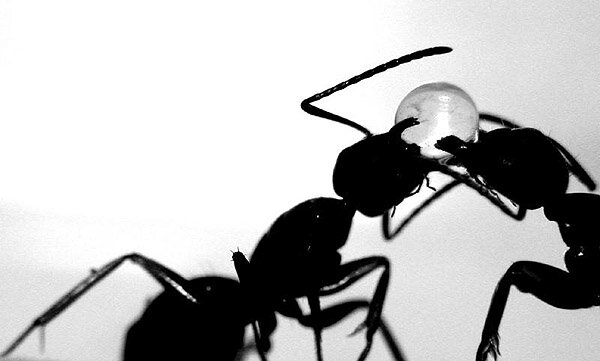
 is a photographer who specializes in insect photography. His website truly is extraordinary and his assiduous documentation of ants is incredibly extensive. This ant's pollinating!
----------------------------------------------------------------------------------
We have so much to learn from the social behavior of diminutive species.
The Virtues of Ants: The individual benefiting from group cooperation, symbiotically interacting with our ecosystem , patience, self-sacrifice, adaptability.
Human traffic congestion issues solved by observing ants sophisticated travel flow algorithims and bio-social systems of cooperation? Sure, why not.
"One dominating factor in human traffic is egoism. Drivers optimize their own travel time, without taking much care about others. This leads to phantom traffic jams which occur without any obvious reason. Ants, on the other hand, are not egoistic."
Exhaustive Book Review of The Superorganism: The Beauty, Elegance, and Strangeness of Insect Societies, discusses fascinating aspects of ant lifeYou should really read the review, but i know you won't:
"Parallels between the ants and ourselves are striking for the light they shed on the nature of everyday human experiences. Some ants get forced into low-status jobs and are prevented from becoming upwardly mobile by other members of the colony. Garbage dump workers, for example, are confined to their humble and dangerous task of removing rubbish from the nest by other ants who respond aggressively to the odors that linger on the garbage workers' bodies."
"Some of the most fascinating insights into ants have come from researchers who measure the amount of carbon dioxide given off by colonies. This is rather like measuring the respiration rate in humans in that it gives an indication of the amount of work the superorganism is doing. The researchers discovered (perhaps unsurprisingly) that colonies experiencing internal conflict between individuals seeking to become reproductively dominant produce more CO2 than do tranquil colonies where the social order is long established. But extraordinarily, they also discovered that about three hours after removing a queen ant, the CO2 emissions from a colony drop. "Removing the queen thus has a clear effect on worker behavior, apparently reducing their inclination to work for the colony," the researchers concluded. While it's dangerous to anthropomorphize, it seems that ants may have their periods of mourning just as we humans do when a great leader passes from us."
"The means that ants use to find their way in the world are fascinating. It has recently been found that ant explorers count their steps to determine where they are in relation to home. This remarkable ability was discovered by researchers who lengthened the legs of ants by attaching stilts to them. The stilt-walking ants, they observed, became lost on their way home to the nest at a distance proportionate to the length of their stilts."
"Pheromone trails are laid by ants as they travel, and along well-used routes these trails take on the characteristics of a superhighway. From an ant's perspective, they are three-dimensional tunnels perhaps a centimeter wide that lead to food, a garbage dump, or home. If you wipe your finger across the trail of ants raiding your sugar bowl, you can demonstrate how important the pheromone trail is: as the ants reach the spot where your finger erased their trail they will become confused and turn back or wander. The chemicals used to mark such trails are extraordinarily potent. Just one milligram of the trail pheromone used by some species of attine ants to guide workers to leaf-cutting sites is enough to lay an ant superhighway sixty times around the earth."
"Some ant species do not have queen ants in the strict sense. Instead, worker ants (which are all female) that have mated with a male ant become the dominant reproductive individuals. These are the gamergates, or "married workers," and their sex life can be brutal. In one species the gamergates venture outside of the nest to attract a male, engage him in copulation, then carry him into the nest before snipping off his genitals and throwing away the rest of his body. The severed genitals continue to inseminate the gamergate for up to an hour, after which they too are discarded. The fertilized gamergates then vie for dominance, causing disruptive conflict in the nest. Sometimes an oligarchy of gamergates is established, but in other instances a single gamergate triumphs. You might think that such an established gamergate would watch the colony carefully for signs of emerging rivals, but this is not the case. Instead it's the worker ants that do so by taking a keen interest in the sexual status of their sisters. If they sense that one is becoming a sexually active gamergate, they will turn on her, either assaulting her or watching carefully until she produces eggs, which they promptly consume. It's intriguing that the sterile workers play the role of monitoring and regulating the sexual life of the colony. In a stretch of the imagination, I can see parallels between this behavior and the role of policing and censuring the sex lives of the rich and famous that gossip magazines play in our own society."
"The progress of ants from this relatively primitive state to the complexity of the most finely tuned superorganisms leaves no doubt that the progress of human evolution has largely followed a path taken by the ants tens of millions of years earlier. Beginning as simple hunter-gatherers, some ants have learned to herd and milk bugs, just as we milk cattle and sheep. There are ants that take slaves, ants that lay their eggs in the nests of foreign ants (much like cuckoos do among birds), leaving the upbringing of their young to others, and there are even ants that have discovered agriculture. These agricultural ants represent the highest level of ant civilization, yet it is not plants that they cultivate, but mushrooms. These mushroom farmers are known as attines, and they are found only in the New World. Widely known as leafcutter ants, they are doubtless familiar from wildlife documentaries. The attines, say Hölldobler and Wilson, are "Earth's ultimate superorganisms," and there is no doubt that their status is due to their agricultural economy, which they developed 50 to 60 million years before humans sowed the first seed. Indeed, it is in the changes wrought in attine societies by agriculture that the principal interest for the student of human societies lies. The most sophisticated of attine ant species has a single queen in a colony of millions of sterile workers that vary greatly in size and shape, the largest being two hundred times heavier than the smallest. In the case of the attines, however, the varying size classes have specific jobs to do. Some cut a piece from a leaf and drop it to the ground, while others carry the leaf fragment to a depot. From there others carry it to the nest, where smaller ants cut it into fragments. Then ants that are smaller still take these pieces and crush and mold them into pellets, which even smaller ants plant out with strands of fungus. Finally, the very smallest ants, known as minims, weed and tend the growing fungus bed. These minute and dedicated gardeners do get an occasional outing, however, for they are known to walk to where the leaves are being cut and hitch a ride back to the nest on a leaf fragment. Their purpose in doing this is to protect the carrier ants from parasitic flies that would otherwise attack them. Clearly, not only did the attines beat us to agriculture, but they exemplified the concept of the division of labor long before Adam Smith stated it. You may not believe it, but like the sailors of old the leafcutter ants "sing" as they work. Leaf-cutting is every bit as strenuous for the ants as hauling an anchor is for human beings, and their singing, which takes the form of stridulation (a sound created by the rubbing together of body parts), assists the ants in their work by imparting vibrations to the mandible that is cutting the leaf, enhancing its action in a manner akin to the way an electric knife helps us cut roasts. The leafcutters also use stridulation to cry for help, for example when workers are trapped in an underground cave-in. These cries for help soon prompt other ants to rush in and begin digging until they've reached their trapped sisters. The fungus farmed by the leafcutter ants grows in underground chambers whose temperature, humidity, and acidity are precisely regulated to optimize its growth. The fungus, which produces a tiny mushroom, grows nowhere else, and genetic studies reveal that various attine ant species have been cultivating the same fungus strain for millions of years. In truth, after tens of millions of years of coevolution such is their interdependence that the ants cannot live without the fungus, nor the fungus without the ants. The system is not perfect, however, for the ants' fungal gardens are occasionally devastated by pests. One of the worst is an invasive fungus known as
Escovopsis, whose depredations can become so severe that the leafcutters must desert their hard-won gardens and start elsewhere anew. Often a colony so beset evicts a smaller attine colony, taking over the premises and enlarging them to suit. Fortunately, the ants possess a potent defense against this fungal weed that usually prevents its proliferation. Their fungicide is produced by a bacterium that is found only in pits located on specific parts of the ants' bodies, and that is known to exist nowhere else. These bacteria produce secretions that not only destroy the
Escovopsis pest, but promote the growth of the fungus the ants wish to cultivate. Thus these special bacteria must be considered as comprising the third element in a triumvirate of coevolved organisms, whose fate is now so closely interwoven that they are utterly interdependent and form a single, functional whole. Humanity's dependence upon a few grains—principally wheat and rice—and the complete dependence on cultivated varieties of these plants by human farmers presents a similar symbiosis.""
So think twice before you temerariously squash these sophisticated critters.
------------------------------------------------------- -------------
More Alex Wild:
An Australian seed-harvesting ant in the genus
Meranoplus drags a seed back to her nest.

Mating
Acropyga ants, the queen carrying a mealybug in her mandibles.
Acropyga ants feed on secretions by root-feeding mealybugs, and the mealybugs depend on the ants for dispersal and protection. When young queen ants leave the nest to mate and start new colonies, they carry their nest-founding mealybug with them.

Ants as earthbound creatures are not ideal pollinators, but they can carry pollen over short distances.

Ant colonies maintain social cohesion through the frequent sharing of regurgitated liquid food. This activity is called trophallaxis, seen here among painted members of a laboratory study colony.
---------------------------------------------------------
And finally, My personal favorite parasitic-symbiotic-interspecial relationship:
Zombie ants.